
Juniper Hedge Spacing: How Far Apart to Plant for Privacy
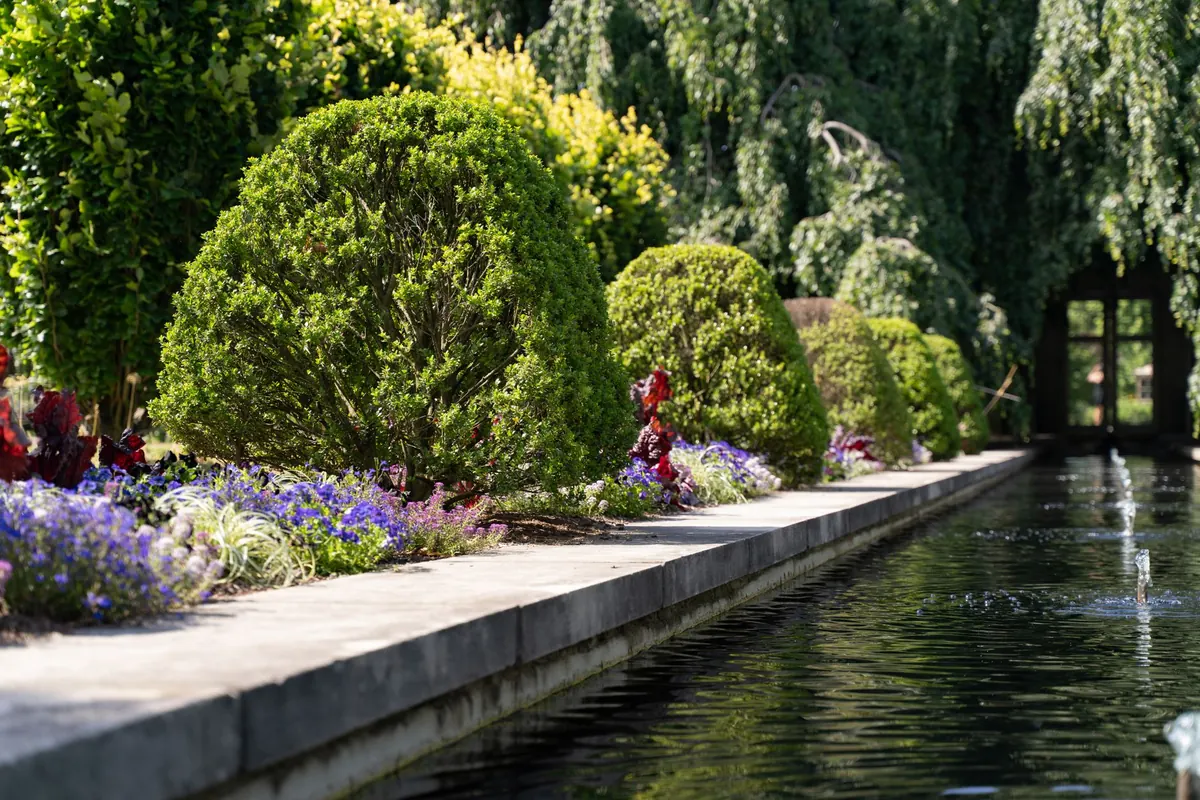
Junipers make excellent privacy hedges. They are evergreen, tolerant of wind and poor soil, and they ask for very little once they are settled. The difficulty is that they are slow to fill gaps and unforgiving of crowding. Get the spacing right at planting and your screen will knit into a solid wall of foliage within a few years. Get it wrong and you will spend the next decade looking at bare stems, dieback and a hedge that never quite closes.
Start With the Mature Width, Not the Pot
Every spacing decision comes back to one number: the mature width of the cultivar you have chosen. Not the width of the plant sitting in the pot, and certainly not the spacing a neighbour used for a completely different conifer.
Labels often give a spread for a plant grown in isolation. In a hedge, junipers behave a little differently. They grow tall and narrow because they are competing for light and being nudged into shape, so the width you actually need to plan for is usually slightly less than the label suggests. That is why the standard approach works so well: plant at roughly half the mature width for a tight, formal line, or about two-thirds of it for a screen that still looks dense from a few metres away. Plant at the full mature width apart and you will be looking at gaps for years.
As a rule of thumb, columnar junipers planted at half their listed spread will touch within three to five growing seasons. Most upright forms put on roughly 15–30 cm of growth a year, so patience is part of the calculation.
Spacing by Juniper Type
The right figure depends entirely on the habit of the plant. Use these as starting points and adjust for your site.
- Narrow columnar types (Irish juniper, Juniperus scopulorum 'Skyrocket', 'Blue Arrow'): 40–60 cm apart in a single row. These are the best choices for a slim boundary screen.
- Medium upright types (Juniperus chinensis 'Spartan', J. scopulorum 'Moonglow'): 60–90 cm apart. You get a fuller, more substantial hedge, but it will need more room.
- Broadly upright and bushy forms (Juniperus × media 'Pfitzeriana'): 90–120 cm apart if you want a solid mass rather than individual specimens.
- Ground-cover junipers (J. squamata 'Blue Carpet', J. horizontalis): space at half the spread. A plant that reaches 2 m across goes in at 1 m centres.
- Dwarf garden forms: keep them out of hedge planning altogether. They will never make a screen, however many you buy.
If you are planting for wildlife as well as privacy, a little extra room between plants lets light reach the base and keeps the lower branches alive — which is where birds tend to nest.
How Many Plants Do You Need?
Once you have chosen a spacing, the arithmetic is simple. Work it through before you order, because junipers are rarely cheap and a shortfall means a mismatched row.
- Measure the length of the run in metres, allowing for the finished hedge to stop short of gateways and paths.
- Choose your planting centres in metres — say 0.45 m for a narrow columnar juniper.
- Divide the run by the spacing: 12 m ÷ 0.45 m = 26.7.
- Round up, then add one for the final plant: 27 + 1 = 28 plants.
- Order five to ten per cent extra as replacements for any that fail in the first winter.
- Mark every position with a cane and run a string line down the row before you dig a single hole. It takes ten minutes and saves a wonky hedge.
Planting Depth: Where Most Juniper Hedges Fail
Junipers are far more likely to be killed by planting depth than by spacing. They hate being buried. The point where the trunk meets the roots — the root flare — must sit at or just above the finished soil level, never below it.
Dig the hole about twice as wide as the rootball but no deeper than the rootball itself. Set the plant in, check the flare against a straight edge laid across the hole, and adjust the base of the hole rather than adding loose soil under the roots, which will settle and drop the plant. If your soil is heavy clay, plant two or three centimetres proud and mound soil up to the rootball, and mix a handful of grit into the backfill. Junipers in waterlogged ground are a short-lived investment.
Tease out any circling roots before planting, firm the plant in with your heel, and water thoroughly. A mulch of bark or compost, kept clear of the stems, will hold moisture and keep weeds down.
Plant slightly high in clay, slightly low in sand, and always at the same depth the plant was growing in its pot.
One Row, Two Rows, and Room to Breathe
A single row is the right answer for most gardens. It is easier to prune, easier to keep straight and it takes up less of your border. Choose spacing at the tighter end of the range if you want the screen to close quickly.
Two rows are worth considering on an exposed, windy boundary, or where you want the hedge to look substantial from day one. Offset the second row by half the spacing so the plants sit in the gaps of the first, and set the rows 60–90 cm apart. Be aware that this doubles your plant bill and produces a hedge roughly 1.5–2 m deep, which is a lot to clip and a lot of shade to garden under.
Whatever layout you choose, leave 45–60 cm between the hedge and any fence, wall or boundary. Air needs to move around the plants, you need to be able to reach the back of the hedge with shears, and roots and branches should not be pressed against structures. If you are planting on a boundary you do not own, or your deeds contain covenants about fencing and planting, it is worth checking the position before you dig. Your local authority or a solicitor can clarify anything unclear.
Aftercare for a Hedge That Knits Together
Water new junipers well through their first two summers — that is the period when most losses happen, particularly in dry spells. Keep the base clear of grass and weeds, which compete fiercely for moisture.
From the second year, tip back the leading shoots lightly in late spring or early summer. This encourages side growth rather than height and helps the hedge thicken from the base upwards. Clip once or twice a season, but never cut back into old, bare wood: junipers are reluctant to regrow from it, and you will be left with a permanent brown patch. Trim on a dull day rather than in strong sun, which can scorch freshly exposed foliage.
Getting the Spacing Right First Time
Measure your run, find the mature width of your chosen juniper, and plant at half that distance for a dense screen. Dig wide holes, keep the root flare at soil level, and give the plants room to breathe against fences and boundaries. A single straight row is usually the best answer; a staggered double row is the answer if you garden on a windy hill and do not mind the extra cost and clipping.
Then leave them to it. Junipers reward good preparation with decades of quiet, undemanding coverage — the sort of hedge you stop noticing because it simply does its job.
Photo: Brett A / Pexels